Are You Managing Digester Flow or Organic Loading?
Consistent pumping volume doesn't necessarily mean consistent organic loading. Changes in feedstock solids concentration can significantly affect the mass of volatile solids entering an anaerobic digester, even when flow rates remain unchanged. This article explores why measuring and managing organic loading, rather than volume alone, helps operators make more informed feeding decisions and maintain more consistent digester operations.
TL;DR
- Consistent feedstock flow doesn't necessarily mean consistent organic loading.
- Changes in solids concentration can significantly change the amount of organic material entering a digester, even when pumping volumes stay the same.
- Measuring feedstock composition helps operators make more informed feeding decisions and manage digester performance.
Alchemyca Signals | Field Notes
At most anaerobic digestion facilities, operators know how much material they're pumping into the digester. They have flow meters, pump schedules, tank levels, and records of incoming feedstock.
But knowing how many gallons are going in doesn't necessarily tell you how much organic material the digester is receiving.
That distinction came up in a recent conversation with an operating team that has been taking a closer look at how it manages feedstock loading. The team described a shift from managing primarily by pumping volume to managing the actual mass of volatile solids entering the digester.
It's an important change in how operators think about feeding the biology, and it raises a question worth considering: If you're pumping the same volume every day, are you actually feeding your digester consistently?
The Same Volume Doesn't Always Mean the Same Load
Organic loading rate (OLR) measures the amount of organic material fed to a digester relative to its working volume over time. It's commonly expressed as kilograms of volatile solids (VS) per cubic meter of digester volume per day.
Flow rate is one part of that calculation. The concentration of volatile solids in the feedstock is another.
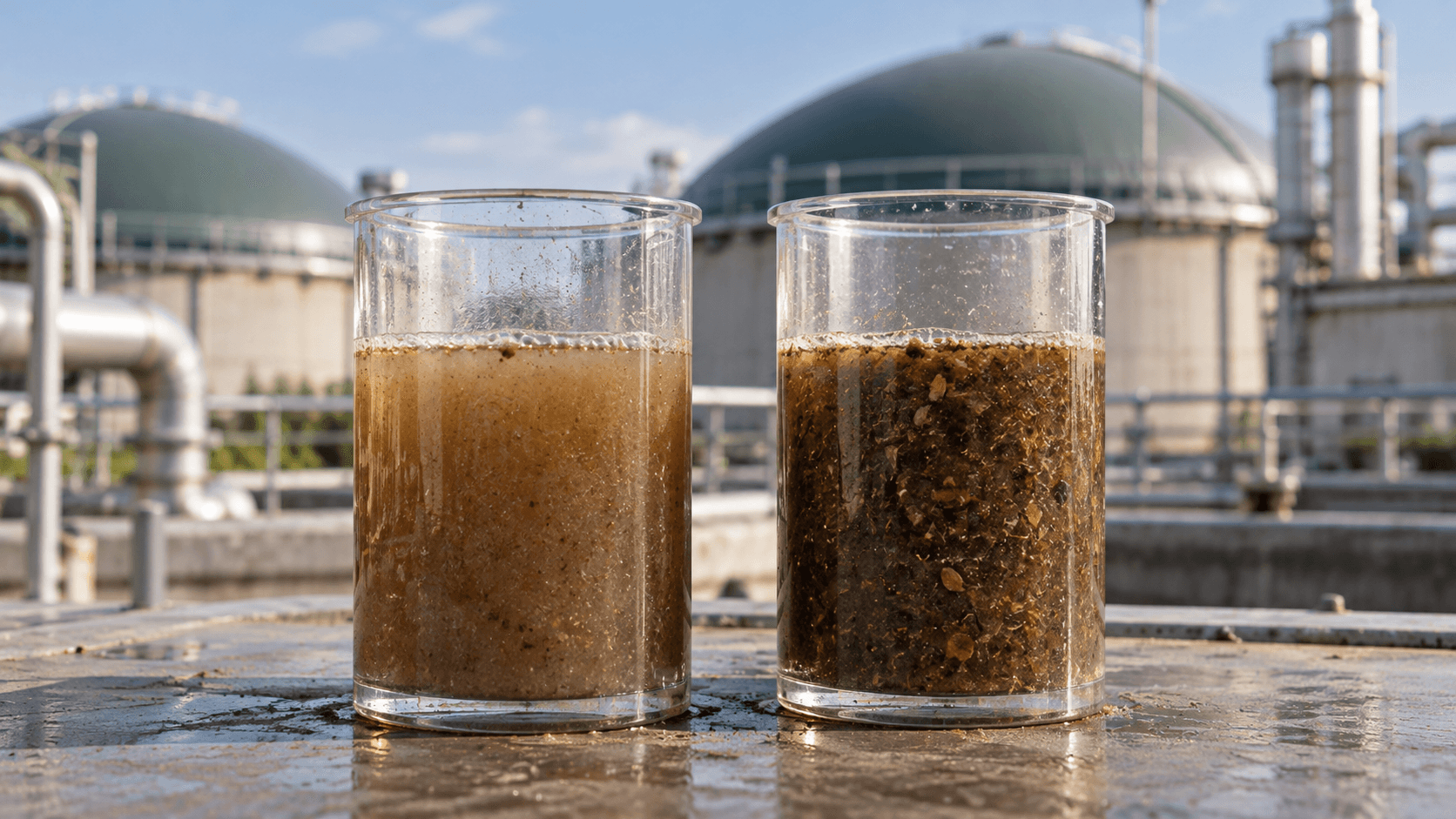
Consider a facility that pumps the same volume of feedstock into its digester on two consecutive days. On the first day, the material contains 6% total solids. On the second day, it contains 8%.
Assuming the proportion of volatile solids within the total solids remains the same, and the feedstock density is unchanged, the second day's organic loading is approximately 33% higher.
The pumping volume hasn't changed. The amount of organic material entering the digester has.
For facilities receiving variable feedstocks, particularly food waste and other co-digestion materials, changes in solids concentration can be a regular part of operations. Even material arriving from the same source may vary from one delivery to the next.
If operators are managing primarily by volume, those changes may not be apparent.
When Consistent Pumping Creates Inconsistent Loading
A plant can follow its pumping schedule precisely and still experience substantial variation in organic loading.
When volatile solids concentration increases, the digester receives more organic material even if the volume being pumped stays constant. When the concentration decreases, the opposite happens.
These variations can affect digester performance and make it harder to understand what's happening inside the process.
For example, an increase in biogas production might simply reflect a higher organic load rather than an improvement in how effectively the digester is converting the incoming material.
Conversely, a change in feedstock concentration could increase the load on the biology without the operating team realizing that anything has changed.
If operators aren't tracking the actual organic load, they may struggle to connect changes in digester performance with changes in what they're feeding.
This is an important distinction. A consistent pumping schedule is a measure of mechanical operation. It isn't necessarily a measure of consistent biological loading.
What Does Managing Organic Loading Require?
Managing toward a more consistent organic loading rate requires two fundamental pieces of information: how much material is being fed and how much volatile solids that material contains.
Most facilities already have a reasonable handle on the first.
The second can be more difficult.
Conventional total solids and volatile solids testing requires collecting samples and completing laboratory analysis. Depending on the facility's procedures and available resources, results may not be available until the following day.
That creates a practical challenge. Operators may be making today's feeding decisions using information about yesterday's feedstock.
We've also heard from plant teams about the time involved in bringing laboratory results together with flow data, calculating organic loading rates, and reviewing trends. The measurements may be available, but not necessarily in a form that makes them easy to use during daily operations.
Near-real-time feedstock characterization, including properly calibrated near-infrared (NIR) measurements, can help close that gap.
By combining timely solids measurements with flow data, operators can estimate the mass of volatile solids entering the digester and make more informed decisions about pumping volumes.
Reliable measurements remain essential. NIR models need appropriate calibration and validation, and representative sampling matters, particularly with heterogeneous feedstocks.
The objective isn't simply to generate more data. It's to make information about the actual organic load available when operators can use it.
Managing the Biology, Not Just the Pumps
One of the more interesting observations from our recent customer conversations has been how better feedstock information can change the operating team's approach.
In one discussion, operators described moving away from pumping decisions driven primarily by the need to move material through the facility. Instead, they were beginning to focus on the mass of volatile solids being fed and how consistently they could manage that loading.
The shift wasn't about replacing operator experience or automating every feeding decision. It was about giving the team a more meaningful basis for making those decisions.
Rather than asking only how many gallons had been pumped, they could also ask how many kilograms of volatile solids had entered the digester.
That information gives operators a way to relate daily feeding activities more directly to the biological process they're managing.
It also creates an opportunity to be more deliberate about adjustments. If feedstock concentration changes, the operating team can consider whether pumping volumes should change as well.
Of course, every facility has its own constraints. Feedstock availability, storage capacity, hydraulic retention time, equipment limitations, and other operating requirements all influence what's practical.
Maintaining an absolutely constant organic loading rate isn't necessarily the goal. Understanding the actual loading, and managing it within an appropriate operating range, is the more important objective.
A Different Way to Think About Consistency
In many facilities, consistency is understandably associated with keeping equipment running according to schedule. Pumps operate at established rates, feedstock moves through the system, and daily throughput targets are met.
Those are important operating responsibilities.
But the biology doesn't respond to the pumping schedule. It responds to the characteristics and amount of material entering the digester, along with the conditions under which that material is processed.
Two days of identical pumping volumes can represent very different biological loading conditions.
That's why measuring the organic fraction of the feedstock matters. It allows operators to distinguish between moving a consistent volume of material and delivering a consistent mass of organic material to the digester.
Although each facility is different, that distinction can be useful anywhere feedstock composition varies and operating teams are trying to maintain stable, efficient digestion.
Signals Takeaway
Managing feedstock by pumping volume and managing by organic loading are not the same thing.
A facility can maintain a consistent pumping schedule while the actual amount of organic material entering its digester changes significantly. Without timely information about volatile solids concentration, those changes may be difficult to recognize or account for in day-to-day operating decisions.
Better feedstock characterization, combined with existing flow measurements, gives operators a clearer understanding of what they're feeding and a more meaningful basis for managing the process.
The insight from our recent customer conversations is straightforward: knowing how much material you're moving is useful. Knowing how much organic material you're feeding gives you a better basis for managing the biology.
At Alchemyca, we're working with facilities to bring feedstock characterization and operating data together so teams can make more informed decisions about digester loading and performance.
If you're interested in taking a closer look at how organic loading is managed at your facility, we'd be glad to talk.
“A consistent pumping rate doesn't necessarily mean a consistent organic load. What matters is how much organic material is actually entering the digester.”