How Far Can You Push Your Digester?

There's a natural pull to get more out of a digester — more feedstock, more gas, more value from an asset already in the ground. But a digester's real limit is rarely the volume on its drawings, and pushing harder isn't always how you get more.
TL;DR
- A digester's real limit is rarely its tank volume — physical, hydraulic, biological, and economic capacity can each be different, and usually one is the binding constraint.
- Pushing harder isn't the goal: peak value can mean more feedstock, different feedstock, or — as one dairy RNG plant showed — the same biomethane on much less feed after a ~58% jump in specific yield.
- Finding the real constraint means connecting feed, biology, output, and economics on one timeline, not watching individual metrics in isolation.
There is a natural economic incentive to get as much value as possible from an anaerobic digester.
For some facilities, that means taking more feedstock and collecting additional tipping fees. For others, it means meeting contractual obligations to accept certain volumes. And for almost every operator, there is pressure to produce more gas from an expensive asset that is already in the ground.
But the economics of the plant and the biology inside the digester do not always move in lockstep.
We have been having more conversations lately with operators who are essentially asking the same question:
How far can we push the system without pushing it too far?
The limit isn’t always where you think it is
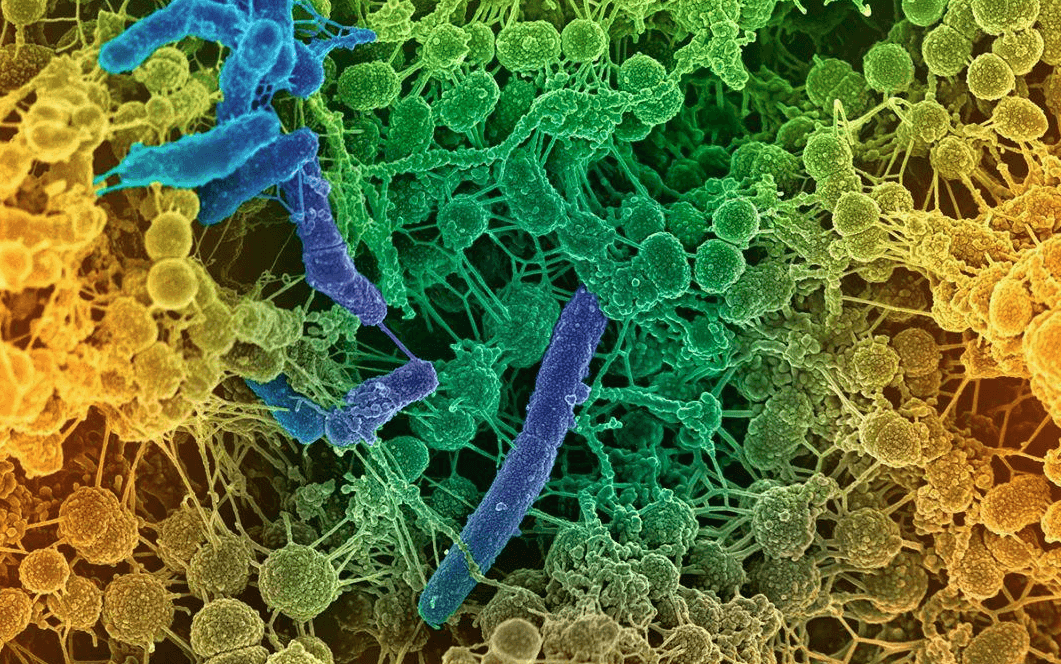
Anaerobic digestion is often talked about as one biological process. In reality, it is a sequence of four interconnected stages: hydrolysis, acidogenesis, acetogenesis and methanogenesis.
Those stages do not operate at the same speed.
Acidogenesis can move very quickly. Acetogenesis is slower. Methanogenesis is slower still and depends on a relatively sensitive community of organisms. That mismatch is important because one part of the process can begin producing intermediates faster than the next stage can consume them.
For example, acidogenic bacteria can reproduce on the scale of hours, while methanogens may have doubling times of several days. If feeding increases faster than the downstream biology can respond, volatile fatty acids can accumulate, pH can begin to change and methanogenic activity can become inhibited.
That is one reason there isn’t a single answer to how much feedstock a digester can handle.
Capacity means more than digester volume
We tend to think about capacity as something physical: the size of the vessel and the amount of material it was designed to process.
But in practice, an operating digester can have several different capacity constraints:
- Physical capacity: How much material can the system physically contain and move?
- Hydraulic capacity: Is material remaining in the system long enough to be converted?
- Biological capacity: Can the microbial community process the organic load without becoming inhibited or unstable?
- Economic capacity: What operating point produces the greatest value from the asset?
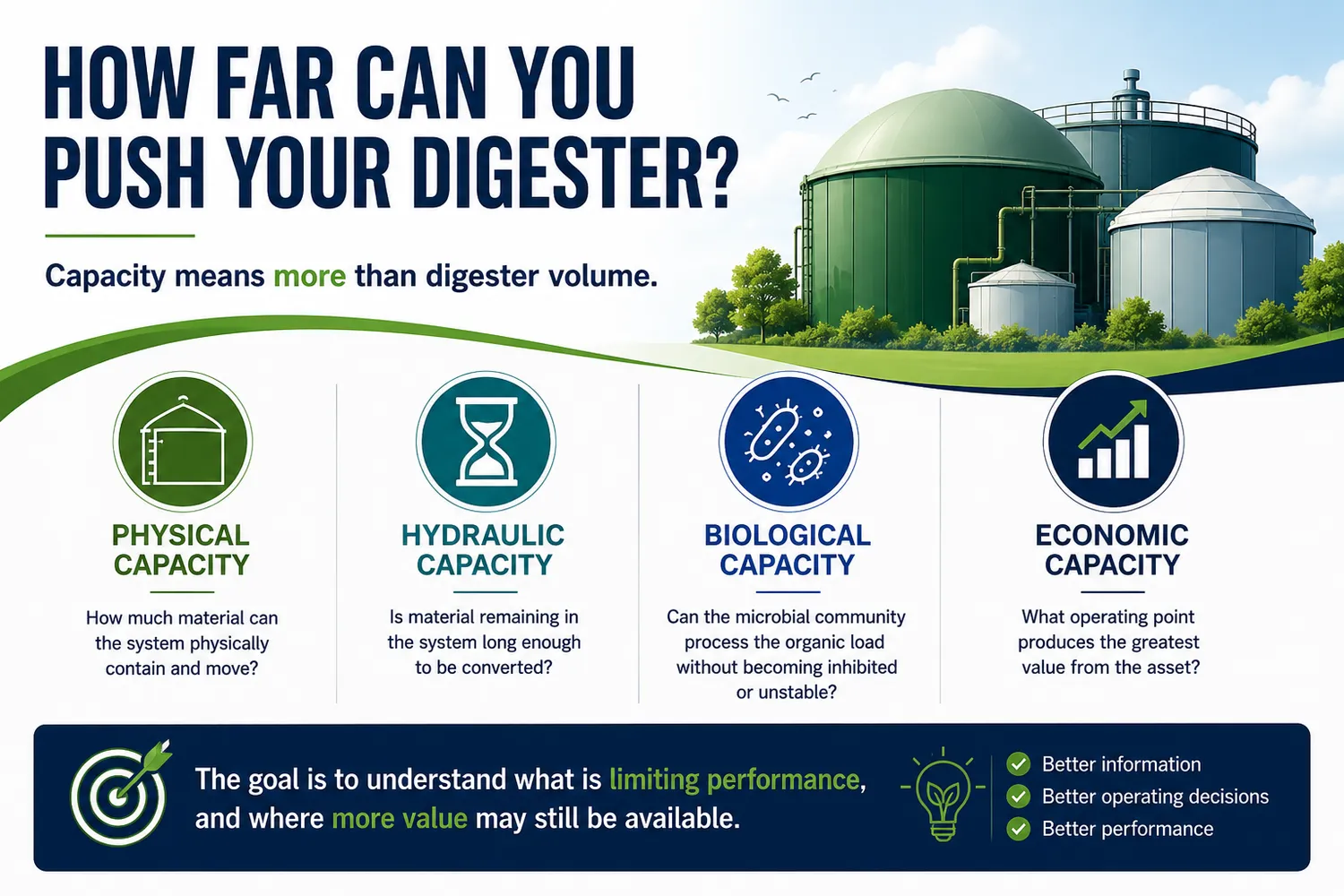
Those limits are not necessarily the same. Ultimately, the question is how to operate the asset at the point that creates the most value.
It isn’t simply the maximum number of tons you can put through the gate. It is the point where feedstock selection, conversion efficiency, biology, gas production and operating costs come together to create the best economic result.
Sometimes the biology is the ceiling
In one recent facility review, the operator identified ammonia inhibition as one of the biological limits constraining how aggressively the plant could operate.
The plant was already managing around that constraint through its feed strategy and dilution. The question wasn’t simply how to prevent an upset. The team wanted to understand whether it could actually raise the biological operating limit and reduce some of the compromises it was making to stay below it.
Instead of asking, How do we keep the plant stable? the question becomes:
What is preventing this plant from operating at a more economically valuable point?
At another facility, the operators had intentionally contracted for more feedstock than they expected to need. That reduced supply risk and gave them options as the facility ramped up. Once the plant was operating, the challenge shifted from securing enough material to understanding which feedstocks would actually create the most value.
A ton of food waste, manure or wastewater treatment sludge is not just a ton of feedstock. Different materials bring different concentrations of volatile solids, energy, protein, fats, carbohydrates, nitrogen and potential inhibitors.
So maximizing feedstock throughput is not automatically the same thing as maximizing digester performance.
Sometimes more performance requires less feed
At a dairy manure RNG plant, a change in operations was followed by a significant improvement in specific biomethane yield.
The plant moved from approximately 120 to 190 cubic meters of biomethane per ton of volatile solids fed, an improvement of approximately 58%. The biology took roughly one hydraulic retention time, about 20 days, to equilibrate, and the higher specific yield remained sustained.
The plant was eventually able to maintain approximately the same output while substantially reducing feedstock input. The opportunity wasn’t more throughput. It was better conversion of the material already going in.
Finding the real constraint
This is where performance intelligence becomes useful.
Most facilities already collect a great deal of data. They have feed records, SCADA data, laboratory results, gas production measurements and operating history.
But those data streams often live separately.
What matters is connecting what is entering the digester with what is happening with the biology, what is leaving the system and what the resulting performance means economically.
The focus then becomes less about watching individual metrics and more about understanding the operating envelope:
If the goal is to get more economic value from the asset, what is limiting performance today?
Is it ammonia? Hydraulic retention time? Organic loading? Feedstock composition? Microbial health? Mixing? An inhibitor coming in with a particular waste stream?
Once the actual constraint is understood, the next question is whether it is fixed or whether it can be moved.
Signals Takeaway
How far can you push your digester?
There isn’t one answer.
A digester’s capacity is not simply the volume printed on its engineering drawings. Physical capacity, hydraulic capacity, biological capacity and economic capacity can all be different.
The opportunity is to understand which constraint is actually limiting the plant today, and whether better information, better operating decisions or changes to the biology can safely expand that operating envelope.
Sometimes that may allow a facility to process more material.
Sometimes it may mean choosing different material.
And sometimes, as we have seen, it may mean producing the same amount of biomethane with significantly less feedstock.
The goal isn’t simply to push the digester harder.
It’s to understand it well enough to know where more performance is still available.
Alchemyca Biotech develops the Claritix™ operational intelligence platform for anaerobic digestion facilities. Sign up for Alchemyca Signals at www.alchemycabiotech.com/signals.