The Biocatalysts Are Only as Good as the Biology They’re Working With

Operators who try biocatalysts report split results — some see a real gas bump, others nothing, or worse. The difference usually isn't the product. It's whether the biology was ready for it, and whether hydrolysis was ever the real constraint.
TL;DR
- Biocatalysts speed up hydrolysis — the first of digestion's four stages — so they only help when hydrolysis is actually the rate-limiting step.
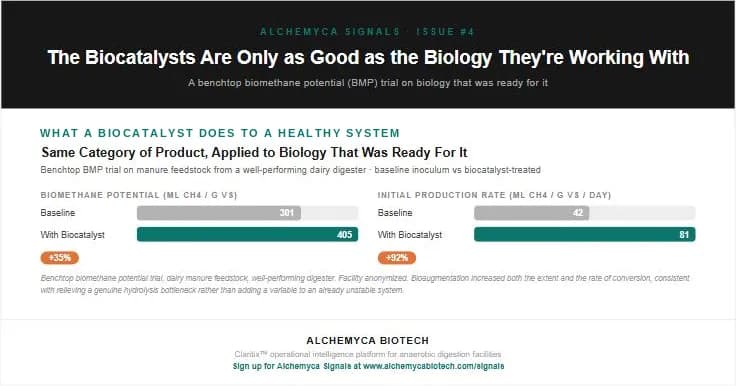
- A benchtop BMP trial on a distressed inoculum showed no room for a front-end biocatalyst to help; a stable, hydrolysis-limited dairy digester saw +35% biomethane potential and +92% initial production rate from the same product.
- The outcome isn't set by the biocatalyst but by the diagnosis going in: characterize the biology, and confirm the bottleneck, before you dose.
Across dozens of conversations with operators who have tried adding biocatalysts, or enzymes as they’re more commonly called, to their digester, the results split about fifty fifty. Some report a real bump in gas output. Others say it did nothing, or made things worse for a few weeks before settling back. Same product category, same general idea, opposite outcomes.
There are a few reasons a biocatalyst can fall flat. Sometimes it’s the wrong biocatalyst for the feedstock. Sometimes it’s dosing or how it was implemented, or simply how the digester is being fed. And sometimes it’s the biology itself, whether the population was actually in a state to respond at all. That last piece is the one operators have the hardest time diagnosing on their own, and it’s the one we want to walk through here.
Four Stages, One Bottleneck
Anaerobic digestion runs through four biological stages, each carried out by a different part of the microbial consortia. Hydrolysis breaks complex feedstock, fiber, protein, fat, down into simpler soluble compounds. Acidogenesis converts those compounds into volatile fatty acids. Acetogenesis converts the VFAs further into acetate, hydrogen, and CO2. Methanogenesis, the final stage, is where methanogenic archaea convert those products into methane.
In most manure and fiber heavy feedstocks, hydrolysis is the slowest of the four stages, and it sets the pace for everything downstream. Biocatalysts are built to speed up that first stage, breaking down structural material faster than the native microbial population can on its own. That only helps if hydrolysis is actually the constraint. Add a biocatalyst to a system that’s already keeping up on hydrolysis, and there’s nothing rate limiting left for it to relieve.
Identifying When the Biology in the Digester Is Distressed
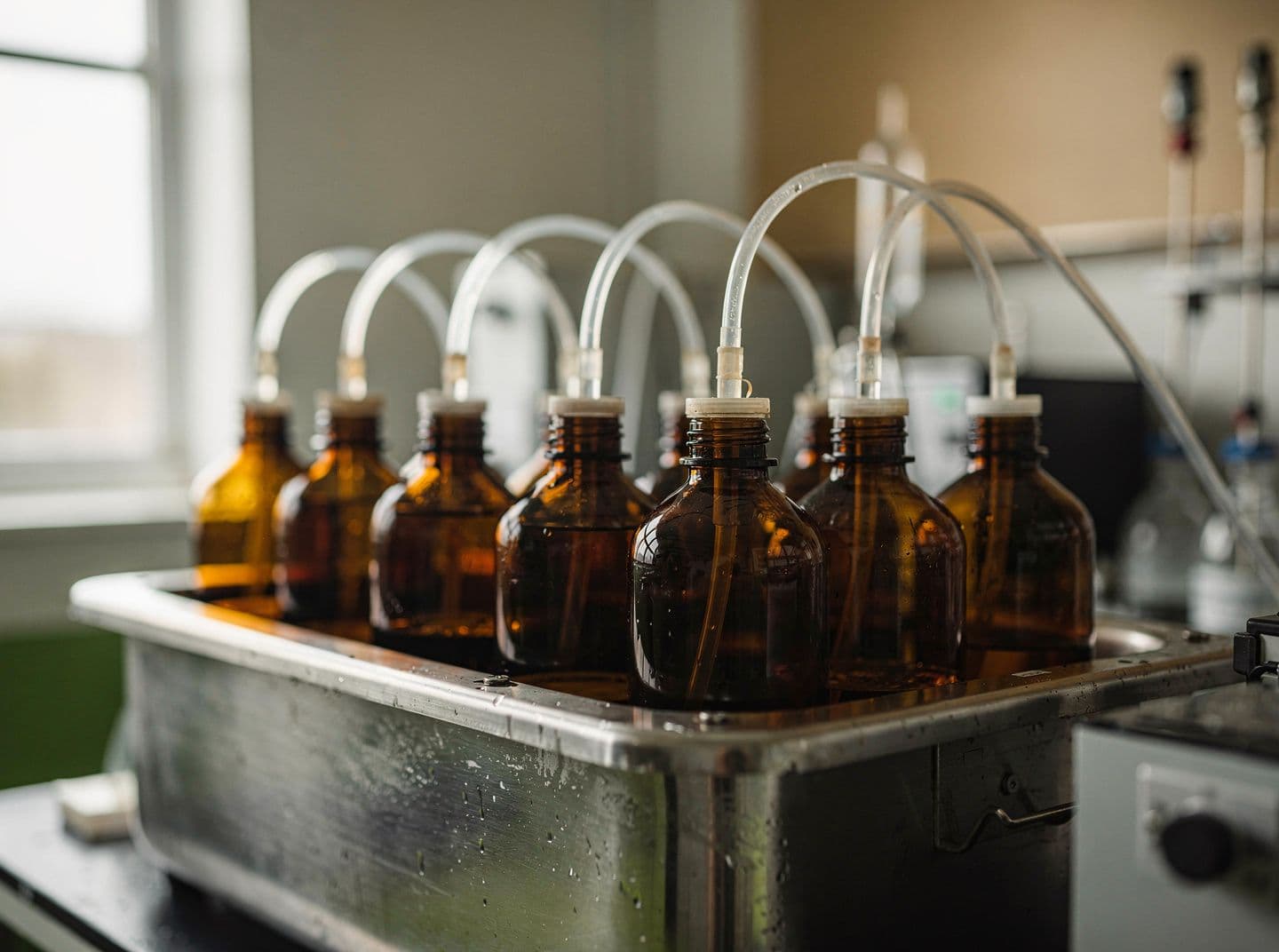
One of the inocula we work with had been showing signs of strain, so before recommending anything we ran a benchtop biomethane potential test against a known healthy inoculum, side by side, to confirm what we suspected. The result matched the expectation: the healthy inoculum performed as it should, and the strained one showed the same distress in a controlled setting that we’d seen in the field.
That confirmed what we expected going in: the distressed population wasn’t going to generate more biogas from a biocatalyst added at the front end of the process. There was no confirmed hydrolysis bottleneck for it to relieve. The population was already working through a backlog of its own.
“Adding a biocatalyst to a system that hasn’t been characterized is a bit like handing someone a faster car when the real problem is the road. You have to know where the actual bottleneck is before you decide what tool fixes it.”
Margaret Slupka, Technical Advisor, Alchemyca Biotech
What Happens When the Biology Is Ready
We expected the opposite result from a different digester, one running on manure from a well performing dairy operation with a microbial community we already knew was stable and hydrolysis limited. The benchtop trial confirmed it: the same category of biocatalyst produced a 35 percent increase in biomethane potential and a 92 percent increase in the initial production rate. Same product, opposite result, because the biology was in a different state going in.
Diagnose Before You Dose
A stressed consortia isn’t a candidate for biocatalysis, and neither is a system where the real limitation is feedstock mismatch, dosing, or how the digester is being fed. Adding a biocatalyst on top of any of those just adds a new variable to a problem it can’t solve. The biology has to be in a stable, characterized state, and hydrolysis has to be the actual constraint, before a biocatalyst can be effective.
That’s the discipline Alchemyca follows: understand what’s actually limiting a system before recommending anything, and apply a biocatalyst only when the diagnosis says it will work.
The Takeaway
A biocatalyst is only as good as the biology it’s added to, and the biology is only one piece of the puzzle. Feedstock fit, dosing, and implementation all matter too. These are two different digesters, not one system before and after treatment. One was biology-limited, so the biocatalyst wouldn’t have helped there no matter what. The other was hydrolysis-limited, which is why it did. What determines the outcome isn’t the biocatalyst, it’s the diagnosis going in.
Are you ready for bioaugmentation? We’d like to work with you to find out.
Alchemyca Biotech develops the Claritix™ operational intelligence platform for anaerobic digestion facilities. Sign up for Alchemyca Signals at www.alchemycabiotech.com/signals.