The Cost of Running Below Design Capacity
Explore the financial impact of operating an anaerobic digester below design capacity, how to identify recoverable production losses, and why understanding the causes of underperformance can help operators prioritize improvements across their facilities.
TL;DR
- 1. Running below design capacity can cost millions in lost RNG revenue, particularly across a fleet of facilities.
- 2. Not all production shortfalls are recoverable through operational changes. Feedstock supply, equipment constraints, and conversion efficiency each require different approaches.
- 3. Identifying recoverable production gaps helps operators prioritize improvements, optimize existing assets, and make better capital investment decisions.
Alchemyca Signals | Field Notes
An operator recently told us they believe their digesters are capturing only 65% to 80% of the gas they should be producing. They know there's a gap. What they haven't been able to pin down is why.
We've heard similar concerns from other operators. Some facilities are still working toward design production. Others have been running for years without consistently reaching their targets.
For a plant that's been operating below design capacity for years, the financial impact can be substantial. And for operators managing a fleet of digesters, understanding where those production gaps exist and what's causing them becomes even more important.
What does the gap cost?
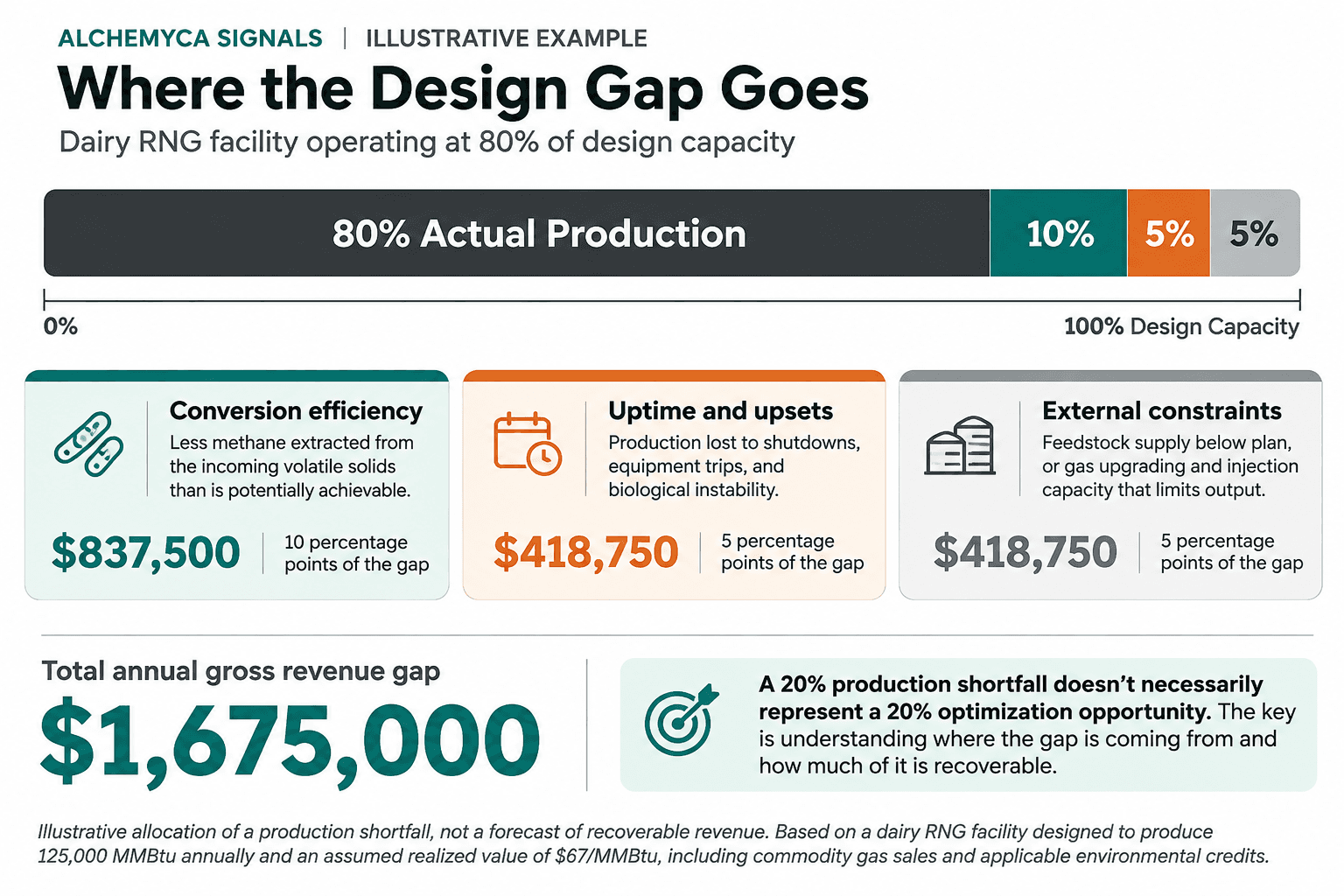
Consider a dairy RNG facility designed to produce 125,000 MMBtu annually.
Using an illustrative realized value of $67/MMBtu, including commodity gas sales and applicable environmental credits, a plant operating at 80% of design would produce 25,000 MMBtu less than planned.
That's approximately $1.7 million in annual gross revenue below its design-based target.
There's another potential cost to poor conversion. Organic material that isn't converted to biogas remains in the digestate, increasing the amount of residual solids the facility has to manage. For plants that pay to transport, process, or dispose of those solids, the financial impact can extend well beyond lost gas revenue.
Across a fleet of 10 comparable facilities, even a 10% average production shortfall would represent more than $8 million annually.
But not all of that shortfall can be recovered through operational improvements. The first step is understanding what's causing it.
Where is the missing gas?
A facility operating at 80% of design has a 20-percentage-point production shortfall. But that shortfall can come from several different sources.
Let's break it down using an illustrative example:
- 10 percentage points from conversion efficiency. The digester isn't extracting as much methane from the incoming volatile solids as it potentially could.
- 5 percentage points from downtime and upsets. Equipment trips, biological instability, and recovery periods reduce annual production.
- 5 percentage points from external constraints. Feedstock supply is below plan, or gas upgrading and injection capacity limits what the facility can deliver.
If feedstock supply is the constraint, the operator may need new contracts. If the upgrading system is limiting production, additional equipment could be required.
But if the digester isn't converting its feedstock efficiently, there may be opportunities to improve performance without making a significant capital investment.
Finding the recoverable gas
When we work with operators, we look closely at how efficiently the digester is converting the organic material it receives. Feedstock composition, loading rates, retention time, and biological health all influence methane production.
A plant's total gas output doesn't necessarily tell you how efficiently that conversion is happening.
A digester can produce a substantial volume of gas while still converting its feedstock inefficiently. Increasing feedstock loading may seem like the obvious way to increase production, but if the biology is already struggling, adding more material can make the problem worse.
One way we assess conversion is through specific methane potential, which measures the methane actually produced per tonne of volatile solids fed to the digester.
Biomethane potential testing tells us what a feedstock could produce under laboratory conditions. Specific methane potential helps us understand what the digester is producing under its actual operating conditions.
Together with feedstock characterization and operating data, this helps identify whether the opportunity is better conversion, greater throughput, or something else.
Optimize first. Invest where necessary.
Before committing capital to increase production, it makes sense to understand what can be recovered from the equipment already in place.
Sometimes the answer is an operating adjustment: changing feedstock loading, improving retention time, or addressing a source of biological inhibition.
Other times, the investigation reveals a physical limitation. A digester with inadequate mixing, for example, may not be bringing the biology into sufficient contact with the substrate. Correcting that problem could require an equipment modification.
The point is to understand the constraint before deciding how to address it.
The fleet-level opportunity
For operators managing multiple digesters, the challenge is deciding where to focus.
Two facilities might both be running at 80% of design, but their opportunities could be completely different. One may be constrained by feedstock availability. Another may have significant room to improve biological conversion.
At Alchemyca, we use Claritix(TM) to bring feedstock characterization, operating data, and performance analysis together. That helps operators identify the factors limiting production, evaluate potential improvements, and measure the results.
Across a fleet, it also provides a way to compare facilities and prioritize the opportunities with the greatest potential economic return.
For fleet operators, understanding which production gaps are recoverable is an efficient way to prioritize operational improvements and capital investments where they can deliver the greatest financial return.
If you're looking to understand where your facilities may be falling short of their production potential, we'd welcome a conversation. At Alchemyca, we work with operators to identify recoverable performance gaps and improve the economics of their existing assets. Reach out to us to explore what that could mean for your facility or fleet.
Economic assumptions: Illustrative U.S. dairy RNG facility designed to produce 125,000 MMBtu annually, using an assumed realized value of $67/MMBtu based on Alchemyca's internal market research. This includes commodity gas sales and applicable environmental credits. Actual revenue depends on credit eligibility, carbon intensity, market conditions, and commercial arrangements. Figures represent gross revenue differences, not lost profit. The allocation of production losses is illustrative and does not represent measured results from a specific facility.
“A 20% production shortfall doesn't necessarily mean there's 20% more gas to recover. Understanding what's causing the gap helps operators focus on the improvements that will deliver the greatest financial return.”