What Is a 5% Improvement in Digester Performance Worth?

What could a 5% improvement in digester performance be worth? Explore how higher methane yields, increased food waste throughput, and reduced biosolids disposal costs can improve the economics of RNG and wastewater facilities.
TL;DR
- A 5% improvement in specific methane yield could generate hundreds of thousands of dollars in additional annual gross revenue for an RNG facility, without increasing feedstock consumption.
- Food waste facilities may be able to increase tipping fee revenue by safely processing more material, while also producing additional biogas.
- For wastewater facilities, improved volatile solids destruction can reduce biosolids disposal costs while increasing energy recovery. Even modest reductions in disposed solids can deliver meaningful savings.
Alchemyca Signals | Field Notes
Even modest improvements in digester performance can generate meaningful financial returns. Here’s what the numbers look like for three types of U.S. anaerobic digestion facilities.
We’ve had a number of conversations recently with digester operators about improving plant performance. Regardless of the type of facility, we are often asked: What would an improvement actually be worth?
The answer is that frustrating “it depends.” But it does depend on how the plant primarily captures value. For example, RNG producers are focused on increasing methane production to generate additional revenue, while municipal wastewater facilities are focused on reduction of biosolids disposal costs. Food waste operators may have the added incentive of tipping fees.
We looked at what a relatively modest 5% improvement could mean for each.
RNG: More Methane From the Same Feedstock
For RNG producers, specific methane yield (SMY) is a useful measure of digester efficiency. It tells you how much methane you’re producing per unit of volatile solids (VS) fed.
A plant might maintain steady gas production for months, but if it takes progressively more feedstock to sustain that output, conversion efficiency is declining. Looking at gas production alone wouldn’t reveal the change.
Improving SMY by 5% means producing 5% more methane from the same VS input, assuming comparable operating conditions.
Here’s what that could mean financially for two illustrative U.S. facilities:
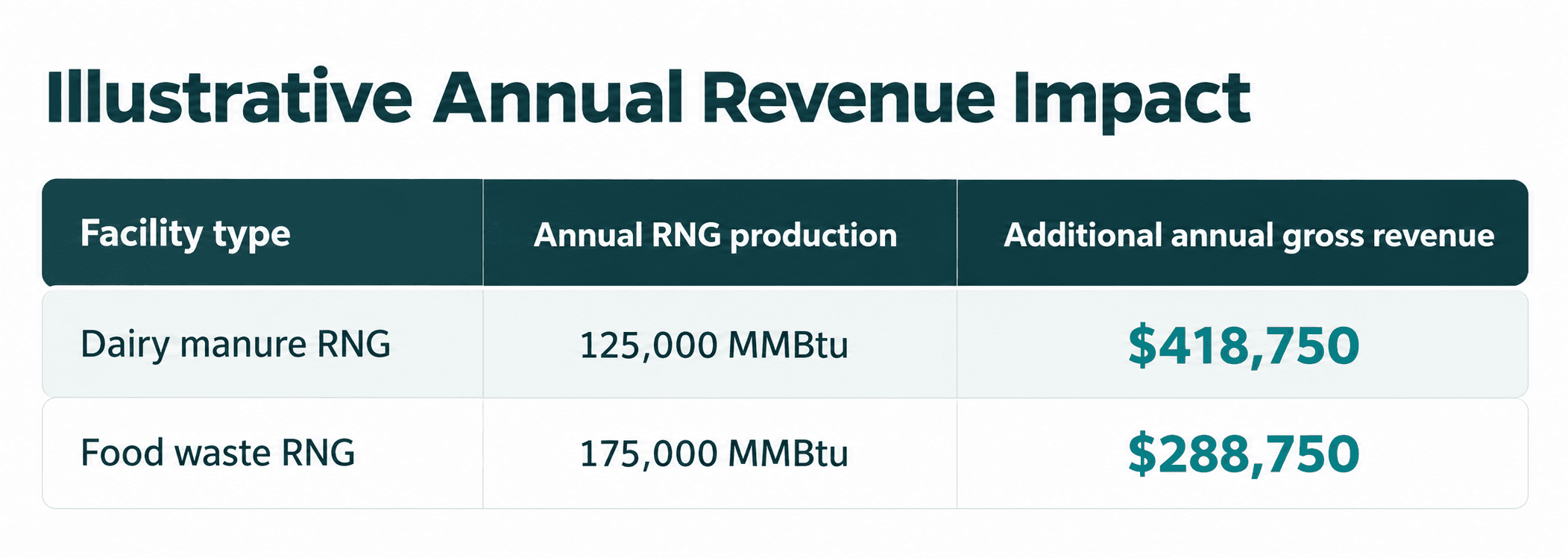
The calculations use illustrative values of $67/MMBtu for dairy RNG and $33/MMBtu for food waste RNG, including assumed gas sales and applicable transportation fuel credits. They assume the additional methane can be upgraded and sold. Actual returns depend on credit eligibility and prices, available capacity, commercial agreements, and incremental operating costs. The figures represent gross revenue, not profit.
For an existing plant, that’s a meaningful potential return without increasing feedstock consumption or adding digester capacity.
Food Waste: More Revenue From Throughput
Food waste facilities have another consideration: tipping fees.
Dependin
g on the plant’s business model, the revenue earned from accepting organic waste may be as - or more - important as the gas it produces.
If a facility has room to increase throughput, it can earn more tipping fee revenue while generating methane from the additional material. The question is how much can you push the process envelop before compromising stability.
That requires an understanding of organic loading, retention time, feedstock variability, and the biological conditions inside the digester. A higher SMY doesn’t automatically increase throughput capacity, but better information about these operating limits can help identify opportunities to accept more material.
For plants with available feedstock and downstream capacity, the financial upside may extend beyond improved methane yield.
Wastewater: Reducing Biosolids Disposal Costs
For municipal wastewater treatment plants, we often find that solids management is a major economic consideration.
These facilities benefit from the electricity and heat generated from biogas, but the costs of dewatering, transporting, and disposing of biosolids can play a much bigger role.
Volatile soli
ds destruction (VSD) is particularly relevant here. It measures the percentage of volatile solids broken down during digestion, and improved destruction can mean less residual organic material to manage.
Consider an illustrative regional wastewater treatment plant processing approximately 40–60 million gallons per day and disposing of 10,000 dry tons of biosolids annually.
At $200 per dry ton, disposal costs total $2 million each year. A 5% reduction in the dry solids requiring disposal would save $100,000 annually.
That calculation assumes a 5% reduction in disposed dry solids, not a 5% increase in VSD. The relationship depends on the proportion of volatile and fixed solids, digestion performance, and downstream treatment.
There’s also an energy benefit. Converting more organic material during digestion can increase biogas production, providing additional fuel for on-site electricity generation or heating. Facilities that upgrade and sell RNG may realize additional revenue instead.
For a wastewater facility, improved digester performance can therefore contribute
to both lower biosolids management costs and greater energy recovery.
Finding the Opportunity in Your Plant
To identify opportunities like these, operators need to look beyond total biogas production.
For RNG facilities, that means monitoring specific methane yield alongside the amount and composition of feedstock entering the digester. Wastewater operators also need reliable measurements of volatile solids destruction and residual solids production.
The challenge is that much of this information comes from periodic laboratory testing, while plant operating data is collected continuously. When these data aren’t brought together, changes in conversion efficiency may be difficult to recognize or diagnose.
Claritix, Alchemyca’s operational intelligence platform, combines feedstock measurements with plant data and analytics to give operators a clearer picture of digester perf
ormance. That makes it possible to identify where efficiency may be slipping, evaluate operating adjustments, and measure the results.
Signals Takeaway
A modest improvement in digester performance can have a meaningful financial impact, but the right measure depends on the plant. For RNG producers, specific methane yield can translate into additional gas revenue. For wastewater operators, better volatile solids destruction can help reduce disposal costs and recover more useful energy. Food waste operators may also find
value in safely increasing throughput.
If you’d like to understand what improved performance could be worth at your facility, we’d be glad to talk. We can help examine the operating data, identify opportunities, and assess the potential economic value.
“A 5% improvement may sound modest, but it can mean hundreds of thousands of dollars in additional revenue or cost savings per year.”