The Hidden Cost of Feedstock Variability

Co-digestion recovers more energy from food waste, but food waste is inherently variable — one load is fats and grease, the next is watery produce. The real challenge operators describe isn't managing the waste. It's managing the uncertainty.
TL;DR
- Unlike manure, food waste is inherently variable — fats and grease in one load, high-moisture produce in the next — and it's as hard to sample representatively as salad dressing.
- When feedstock composition changes unseen, operators can't tell whether a shift in gas production came from their own adjustment or simply a different feedstock.
- Better information doesn't remove variability, but it reduces uncertainty — and increasingly underpins the data behind RNG carbon-intensity and environmental attributes.
We recently spoke with operators, consultants, developers, and utility partners involved in mixed waste anaerobic digestion. Although each facility is different, the conversations often arrive at the same place.
The challenge isn’t simply managing food waste. It’s managing uncertainty.
One of the greatest environmental advantages of anaerobic digestion is its ability to transform food waste and other organic residuals into renewable natural gas while diverting material from landfills. As more facilities expand beyond traditional manure or wastewater sludge into co-digestion, they’re recovering more energy from materials that would otherwise become waste.
That opportunity, however, comes with a new level of operational complexity.
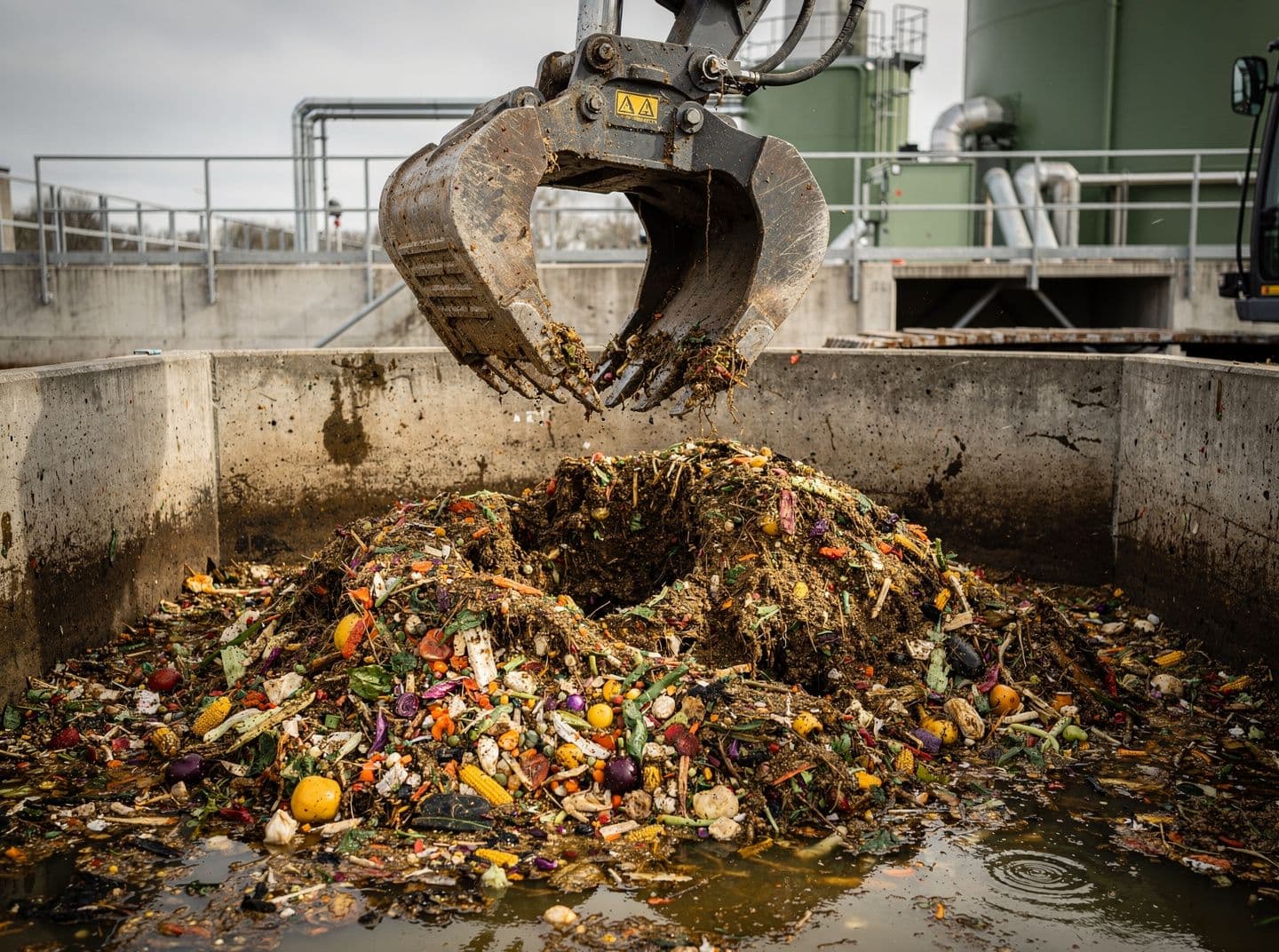
Unlike manure, which is relatively consistent from day to day, food waste is inherently variable. One load may contain fats, oils, and grease.
The next may be primarily produce waste with high moisture content. Seasonal changes, supplier changes, contamination, and collection practices all influence what arrives at the receiving pit.
During one conversation, a consultant compared sampling food waste to sampling salad dressing.
The oil rises to the top. Water settles below. Solids separate into different layers. Trying to collect one representative sample from that mixture is far more difficult than it sounds.
That challenge extends well beyond the laboratory.
When feedstock composition changes unexpectedly, operators are constantly deciding whether to adjust loading rates, modify blending strategies, or simply allow the biology to adapt. Without confidence in what’s entering the digester, it becomes difficult to know whether a change in methane production resulted from an operational adjustment or whether today’s feedstock was simply different from yesterday’s.
Several conversations also highlighted how this uncertainty affects day-to-day decision making.
Should operators increase loading rates or stay conservative? Did yesterday’s process change improve performance, or did a richer feedstock temporarily boost gas production? Is biology responding as expected, or has the incoming material changed enough to alter the outcome?
These questions become increasingly important as facilities pursue higher throughput and maximize renewable natural gas production.
They’re also beginning to influence conversations beyond plant operations.
A recent discussion with a utility partner highlighted another dimension of feedstock variability: confidence in the data supporting environmental attributes.
As renewable natural gas markets mature, carbon intensity becomes increasingly important. Understanding what entered the digester becomes valuable not only for optimizing biology, but also for supporting the environmental performance associated with the gas produced.
One thing became clear as these conversations unfolded. Operators rarely started by talking about environmental credits or carbon intensity. They started by talking about uncertainty.
How do I know what’s coming into the plant today? If gas production changes, was it something I did or simply a different feedstock? Can I confidently increase loading rates, or am I introducing unnecessary risk? Are my lab samples truly representative of what I want to measure?
As more facilities accept a wider range of organic waste streams, those questions become harder to answer.
Better information doesn’t eliminate feedstock variability. But it does reduce uncertainty, giving operators greater confidence in the decisions they make every day.
Signals Takeaway
As anaerobic digestion continues to evolve, feedstock variability is becoming less of an operational challenge and more of an information challenge. The facilities that understand what they’re feeding, in real time, will be better positioned to optimize performance, improve environmental outcomes, and operate with greater confidence.
If feedstock variability is becoming a limiting factor in your operation, we’d be glad to talk. We’ve helped facilities better understand what’s entering their digesters and turn that information into more confident operating decisions.
Sign up for Alchemyca Signals at www.alchemycabiotech.com/signals.