From Design Basis to Daily Delivery
Feedstock can meet its contract and still leave a digester short. What solids content, lab lag and ammonia inhibition mean for RNG feedstock specifications.
TL;DR
- Volume doesn't guarantee quality. Feedstock can meet contractual volume commitments while falling short of the solids content or other characteristics assumed in the digester's design.
- Quality specifications matter. Feedstock agreements should reflect the facility's design requirements, including measurable quality parameters and provisions for off-spec material.
- Testing has practical limits. Operators may not know whether incoming material meets specifications before it enters the process, potentially affecting gas production and biological stability.
Alchemyca Signals | Field Notes
From Design Basis to Daily Delivery: Managing Feedstock Quality
An RNG facility can have enough feedstock under contract to meet its production targets and still struggle to produce the gas it was designed to deliver.
Feedstock selection and characterization are fundamental to digester design. Engineers consider solids content, biomethane potential, organic loading rates, and other characteristics when determining how a facility should perform.
But the specifications used to design a digester don't always carry through to the contracts governing feedstock supply. And once the plant is operating, verifying what actually arrives can be difficult.
What happens when feedstock contracts don't match the design basis?
In one conversation, an operator described how the original design of a dairy RNG facility relied on optimistic assumptions about manure production and gas yield. Those assumptions influenced the project's financial projections and contractual performance targets.
The result was a facility expected to deliver production levels that may not have been achievable with the manure actually available.
We've heard similar concerns about manure solids content. Developers may contract with individual farms for a specified volume of manure, but the amount of organic material in that volume can vary considerably depending on farm practices.
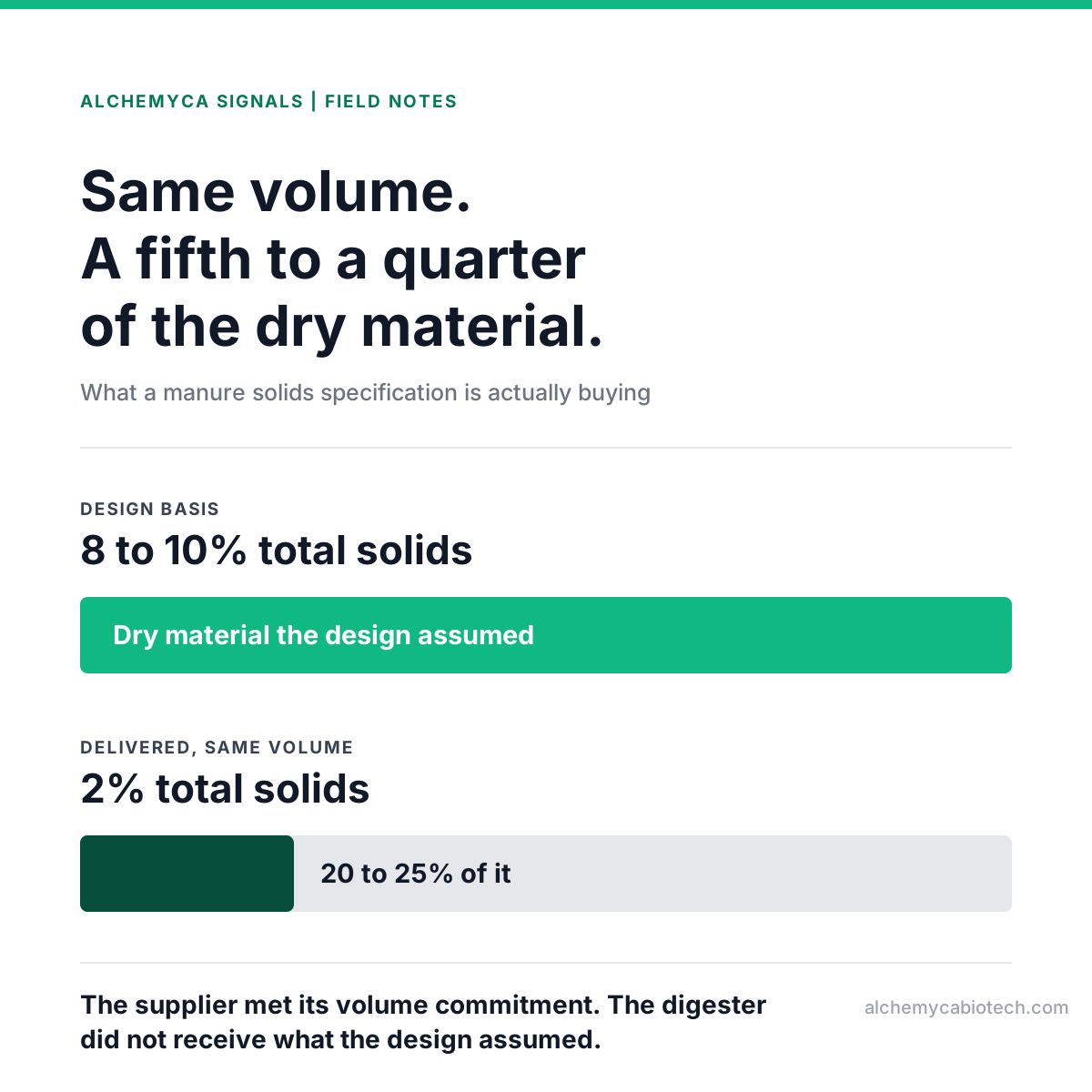
The same volume, a quarter of the dry material
Consider a facility designed around manure containing 8 to 10% total solids. If that manure arrives at 2%, the same volume delivers substantially less dry material: a quarter of it at the low end of the design range, a fifth at the high end.
The supplier may have fulfilled its volume commitment, but the facility is receiving something quite different from what the design anticipated.
Depending on how the supply agreement is written, the operator may have little recourse.
A March 2026 Husch Blackwell analysis of RNG feedstock agreements recommends establishing quality standards, testing procedures, and provisions for handling nonconforming loads. It also recommends aligning feedstock specifications with the digester's performance guarantees.
Those details matter when a facility's revenue depends on producing gas from material supplied by someone else. The same gap shows up day to day as well, in the difference between managing pumping volume and managing organic loading.
How do operators know what is actually arriving?
Food waste operators face a different version of the same problem.
One operator described how material from a regular supplier might consist largely of meat products one day and fruit the next. Both are organic waste, but their composition and expected methane yield can be quite different.
At one municipal co-digestion facility, an operator told us that unusually watery loads sometimes aren't identified until they're already in the system.
At another, samples are taken to the laboratory, but results can take several days. If something goes wrong, the team then has to work backward to identify which hauler or delivery may have contributed to the problem.
Meanwhile, trucks are arriving and material needs to be handled. Depending on the contract and the facility's receiving and storage arrangements, rejecting a load may not be an option.
The U.S. EPA's AgSTAR guidance on co-digestion recommends evaluating feedstock quality before entering supply agreements.
But testing every incoming load adds cost, and some methods aren't practical for making decisions at the receiving gate.
Why can't biomethane potential testing decide whether to accept a load?
Biomethane potential testing is valuable for characterizing a feedstock, but conventional testing takes weeks. It can't tell an operator whether to accept a truck that's waiting to unload.
This is the same lag that makes feedstock variability expensive: the information arrives after the decision has already been made.
Can feedstock meet its specification and still cause problems?
Solids content and methane potential aren't the only considerations.
At one dairy RNG facility we worked with, an inhibitory condition was traced to manure from a particular farm. Once that source was addressed, digester performance recovered. The same tracing problem, at portfolio scale, is what we describe in this dairy RNG case study.
How does nitrogen in feedstock lead to ammonia inhibition?
Nitrogen loading is another concern we've heard from operators, particularly those processing food waste and other protein-rich materials.
As proteins break down during digestion, nitrogen is released and can contribute to ammonia accumulation. At elevated concentrations, ammonia can inhibit methane-producing microorganisms. The severity depends on operating conditions, including pH, temperature, and how well the microbial population has adapted.
One operator described managing ammonia levels by changing the mixture of incoming waste streams. Adding water was an emergency measure, not the preferred solution.
A 2019 review in the Journal of Water Process Engineering examines how ammonia inhibition develops under different digester conditions.
This is also what makes a digester calibrated for biosolids behave differently once it starts receiving food waste.
These examples illustrate why feedstock specifications need to account for more than volume and energy potential. Material can satisfy one set of requirements while creating problems elsewhere in the process.
What should a feedstock specification actually cover?
There are practical limits to what can be specified or tested. Feedstock composition changes, laboratory results take time, and some potential inhibitors are difficult to identify.
Still, the assumptions established during design should inform what suppliers are expected to deliver and how incoming material is evaluated.
That means defining measurable quality parameters where possible, establishing workable procedures for off-spec material, and considering what the operations team can realistically test and manage.
It also means recognizing when a facility has little ability to refuse incoming material. That constraint needs to be understood when the supply agreement is negotiated, not discovered after the plant starts operating.
A feedstock contract may secure the volume needed to run a digester. Whether that material can consistently support the facility's design performance is a separate question, and one worth addressing before the first truck arrives.
Common questions
Can a feedstock supplier meet its contract and still leave a digester short?
Yes. A contract written around volume is satisfied when the volume arrives. If the material is more dilute than the design assumed, the same volume carries less organic material. Manure designed for at 8 to 10% total solids and delivered at 2% supplies a quarter of the dry material at the low end of that range.
Why does solids content matter more than volume?
Because the digester is fed by the organic material in the feedstock, not by the liquid carrying it. Two deliveries of identical volume can represent very different organic loads.
Why can't an operator just test every incoming load?
Testing every load adds cost, and the methods that characterize a feedstock best are the slowest. Biomethane potential testing takes weeks by conventional methods, and laboratory results on a delivered load can take several days, by which time the material is already in the system.
What causes ammonia inhibition in a digester?
Nitrogen released as proteins break down can accumulate as ammonia. At elevated concentrations it inhibits methane-producing microorganisms. How severe that becomes depends on pH, temperature and how well the microbial population has adapted.
What should a feedstock supply agreement include beyond volume?
Measurable quality parameters, testing procedures, provisions for handling nonconforming loads, and specifications aligned with the digester's performance guarantees. It should also reflect whether the facility can realistically refuse a delivery.
Facing feedstock quality challenges at your facility? Talk with Alchemyca.
““It was designed with a very optimistic mass balance.””