What Your Digester Metrics Might Be Missing

Every operator watches gas, kilowatts, loading, methane, pH, temperature. Those numbers tell you what a plant is doing, but not always why. Reviewing a deployment in Italy surfaced two patterns the top-line metrics had completely hidden.
TL;DR
- Top-line metrics tell you what changed, not why — a drop in output could be an operating choice, a feedstock shift, or biology, and the number alone can't say which.
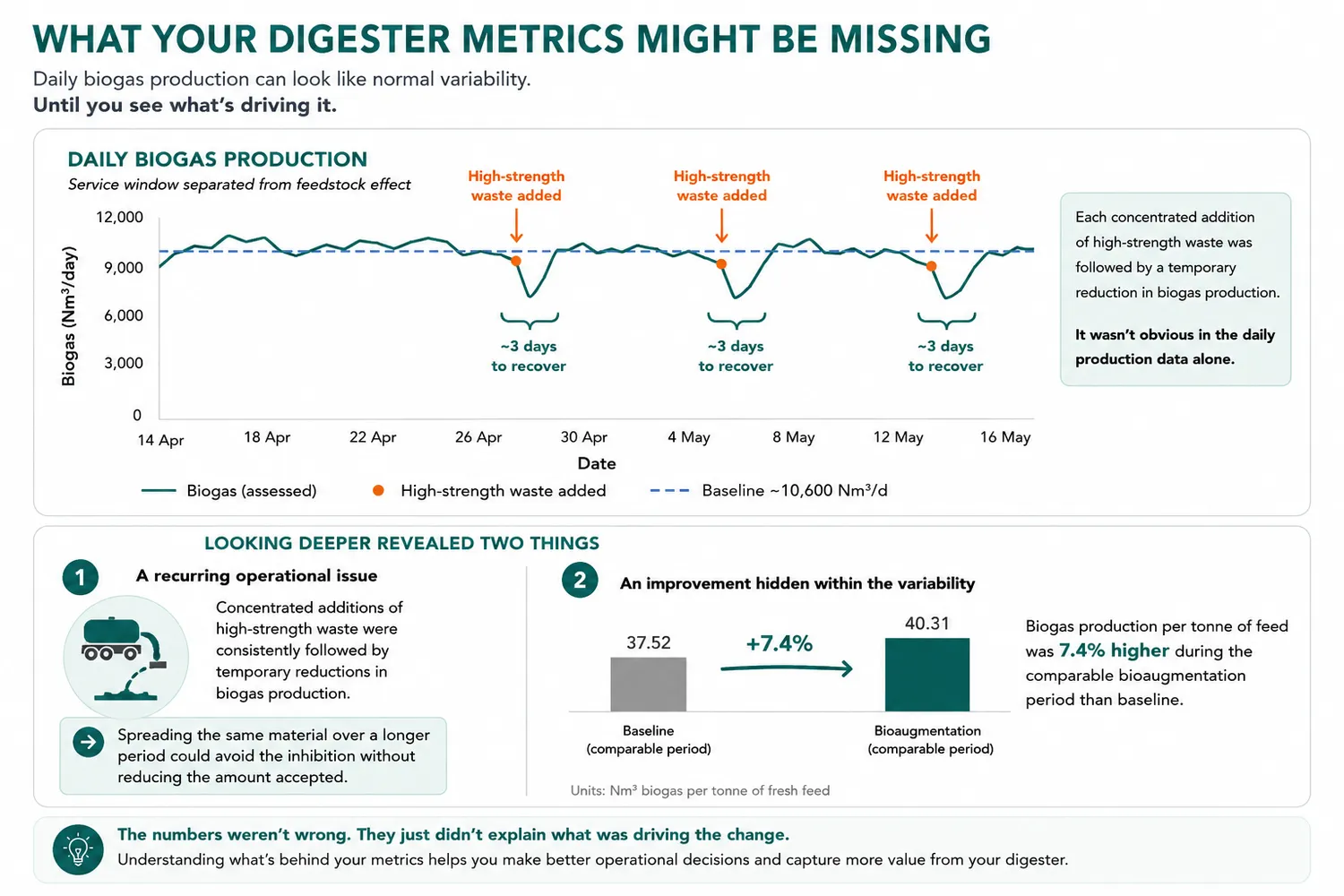
- At an Italian plant, each concentrated high-strength waste addition quietly suppressed biogas for about three days; spreading the same material out avoids the inhibition without accepting less.
- Separating those noisy days also revealed the real signal underneath: +7.4% more biogas per metric ton of feed during the bioaugmentation period.
Every anaerobic digester has a set of metrics that operators watch closely.
Gas production. Electricity generation. Feedstock loading. Methane volume. pH. Temperature.
These numbers are essential for understanding how a plant is performing. But they don’t always tell you why performance changed.
That distinction came into focus for us recently while reviewing data from a deployment at a biogas facility in Italy.
Gas production data at the facility showed a fair amount of day-to-day noise, making it difficult to distinguish meaningful trends from normal variability. At the same time, several other things were happening within the plant. Temperature was changing. The plant went offline for a scheduled service window. Feedstock conditions varied.
And at regular intervals, the facility added a concentrated, high-strength organic waste stream.
Because we were evaluating the impact of a bioaugmentation protocol, we were looking closely at what was behind the changes in production. That’s when a pattern emerged.
Each time the high-strength waste was added, biogas production dropped, taking about three days to return to baseline.
The effect was temporary, but it was consistent. It wasn’t obvious in the daily production data alone, and had gone unnoticed as part of the normal variability in plant performance.
A closer look at the data pointed to organic overload from the concentrated addition. Spreading that same material over a longer period rather than adding it all at once could avoid the inhibition without reducing the amount of material the facility accepts.
That wasn’t the only thing the analysis revealed.
When we separated the high-strength waste addition days and compared otherwise similar operating periods, the impact of the bioaugmentation protocol also became clearer. Despite the recurring production dips and other variability at the plant, the plant produced 7.4% more biogas per metric ton of fresh feed during the comparable bioaugmentation period than during baseline.
Neither pattern was obvious from the top-line performance metrics alone.
And that’s the larger lesson.
Digesters are dynamic biological systems. Feedstock composition changes. Loading changes. Temperature changes. Microbial populations adapt. Inhibition can occur. Operational adjustments overlap with one another.
All of those factors can influence the metrics operators see every day.
If electricity generation drops, for example, the number tells you something important happened. It doesn’t necessarily tell you what caused it.
Likewise, an increase in total gas production doesn’t automatically mean the digester is performing more efficiently. The plant may simply have fed more material or received a higher-energy feedstock that day.
This creates a challenge for operational decision-making.
If you make a change and gas production increases, should you keep doing it? If production falls, should you reverse course? Was the change responsible, or was something else happening inside the digester at the same time?
Operational noise can make good decisions look like bad ones, and bad decisions look like good ones.
In this case, the deployment gave us a reason to examine the plant’s operating data at a level of detail that revealed patterns that had previously gone unnoticed. We were able to see not only the impact of the bioaugmentation protocol, but also an existing operational issue that was repeatedly suppressing production.
That’s an important distinction.
The goal isn’t to replace the performance metrics operators already rely on. It’s to add enough context around those metrics to understand what’s driving them.
As anaerobic digestion facilities become more complex, particularly as they incorporate more varied feedstocks and push existing assets for greater production, that context becomes increasingly valuable.
Knowing what happened is important.
Understanding why it happened is what allows you to decide what to do next.
Signals Takeaway
The metrics we watch every day are essential for understanding digester performance, but they don’t always reveal the biological and operational dynamics driving the result. Looking beyond the outcome can help operators separate meaningful changes from normal variability and make more confident decisions about what to do next.
If your performance data is raising more questions than it answers, we’d be glad to talk. We’ve helped facilities look beyond top-line metrics to better understand what’s driving digester performance and identify opportunities that might otherwise be missed.