The Plant Changes Hands. The Knowledge Doesn't.
What a new owner inherits when an RNG facility is sold, and what gets left behind.
TL;DR
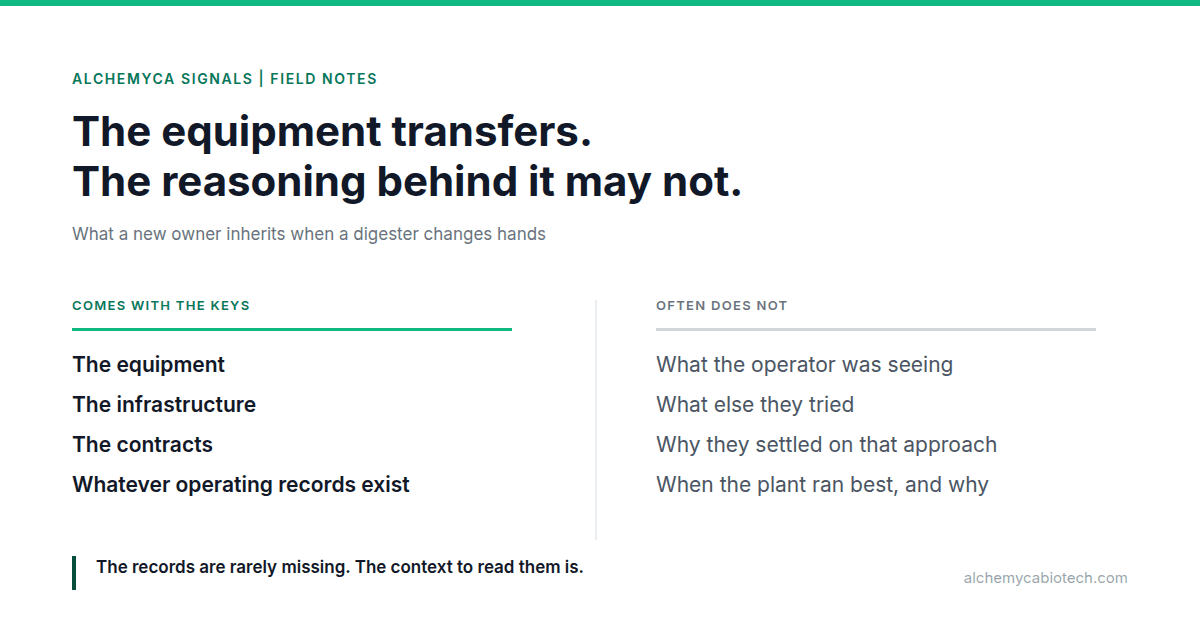
- The equipment transfers. The reasoning often doesn't. A new owner gets the equipment, contracts and records, but rarely what the operator was seeing, what else they tried, or why they settled on an approach.
- The records are rarely missing. The context to read them is. Historian and maintenance records show what changed, not why the team made that call.
- Due diligence should cover operating history, not just equipment. Design assumptions, best-performing periods, past problems, modifications, feedstock changes, and practices held by a few people all belong in the handover.
Alchemyca Signals | Field Notes
In September, we spoke with a new operations contact responsible for a group of dairy digesters. We'd been working with the previous team for months, discussing opportunities to improve performance at the facilities.
The ownership structure had changed, and the people we'd been working with were no longer involved.
Our new contact explained that very little of those discussions had been passed along. He asked us to bring him up to speed on where things had been left.
We could reconstruct much of the conversation, but even we weren't sure which facility the previous team had intended to prioritize.
It got us thinking about how much knowledge can be lost when the people responsible for a digester change.
What does a new owner inherit when a digester changes hands?
As the RNG industry matures, more companies are looking at acquiring operating facilities, including underperforming plants they believe they can improve.
An incoming owner gets the equipment, infrastructure, contracts, and whatever operating records are available. But understanding how the facility arrived at its current performance can take some digging.
What assumptions went into the original design? What problems have already been investigated? What changes were made, and why?
Owners want to know when the plant was performing at its best and what was happening at the time. What were they feeding it? How much? What were the operating conditions? And what changed between then and now?
Those answers can help a new team understand what the plant has achieved before and whether it can get back there.
Why is a digester's operating history so hard to interpret?
This isn't limited to ownership changes.
At one facility, an operations team described inheriting a plant with a complicated history of equipment problems and operating changes. Much of that history predated their involvement.
They'd spent considerable time resolving persistent mixing problems. When we discussed reviewing historical performance, they preferred to focus on recent data because the earlier operating history was difficult to interpret.
The records weren't necessarily missing. The team just didn't have the context to make sense of all of them.
A historian might show when an equipment setting changed. Maintenance records might document a repair. But neither necessarily tells you what the operator was seeing, what else they tried, or why they settled on a particular approach.
What happens when a procedure is understood by only a few people?
One municipal wastewater operator described an equipment regeneration procedure that was essentially a black box understood by only a few people. The procedure had delivered meaningful maintenance benefits, but much of the reasoning remained with those individuals.
If those people leave, the procedure may remain, but the understanding behind it could go with them.
What should an operational handover cover?
For companies acquiring existing RNG facilities, technical due diligence is part of the process. But there's more to understand than equipment condition and recent production figures.
A good operational handover should address:
- The original design assumptions and how they've changed
- When the facility performed best and the conditions at the time
- Previous operating problems and how they were addressed
- Equipment and process modifications made since commissioning
- Changes in feedstock sources and characteristics
- Operating practices that depend on the experience of particular individuals
Not every answer will be available, particularly at older facilities that have been through multiple operators.
But knowing what's documented, what's uncertain, and who might have the answers can save the incoming team from repeating work that's already been done.
How do you rebuild a plant's operational memory?
Every digester has an operating history. Different feedstocks have been tried, adjustments have been made, problems have been solved, and some approaches have worked better than others.
The trouble is that much of what was learned may be scattered across operating records, spreadsheets, lab reports, and the memories of the people running the plant.
This is an area where we're putting a lot of effort into Claritix™.
Today, we can bring historical operating data and process performance together to examine when a plant was running well and what conditions were present at the time. That gives an incoming team a way to look beyond current production and understand what the facility has achieved in the past.
We're also working on the next layer: getting closer to understanding why performance changed.
As we incorporate more operating and feedstock data, along with machine learning and AI, we're working to identify relationships that aren't always apparent from individual measurements or trends. The aim is to better understand which conditions and operating decisions contributed to changes in performance.
There will always be things an experienced operator knows that aren't captured in the data. But the more of that operating history we can preserve and interpret, the less a new team has to figure out on its own.
When a plant changes hands, the next team shouldn't have to relearn everything the previous team already figured out.
Common questions
What does a new owner actually get when an RNG facility changes hands?
An incoming owner gets the equipment, infrastructure, contracts, and whatever operating records are available. But understanding how the facility arrived at its current performance can take some digging.
What should an operational handover for a digester cover?
The original design assumptions and how they've changed, when the facility performed best and the conditions at the time, previous operating problems and how they were addressed, equipment and process modifications made since commissioning, changes in feedstock sources and characteristics, and operating practices that depend on the experience of particular individuals.
Why are a digester's historical records often hard to use?
The records weren't necessarily missing. The team just didn't have the context to make sense of all of them. A historian might show when an equipment setting changed. Maintenance records might document a repair. But neither necessarily tells you what the operator was seeing, what else they tried, or why they settled on a particular approach.
What happens to a procedure that only a few people understand?
The procedure had delivered meaningful maintenance benefits, but much of the reasoning remained with those individuals. If those people leave, the procedure may remain, but the understanding behind it could go with them.
Is technical due diligence enough when acquiring an RNG plant?
For companies acquiring existing RNG facilities, technical due diligence is part of the process. But there's more to understand than equipment condition and recent production figures. Not every answer will be available, particularly at older facilities that have been through multiple operators. Knowing what's documented, what's uncertain, and who might have the answers can save the incoming team from repeating work that's already been done.
If you're acquiring or taking over an existing digester, we'd be glad to show you how Claritix can help you understand its operating history and performance. Talk with Alchemyca.
“[My colleague] and I probably understand the mathematics of it, because we wrote out the code and the script for it... it's a black box in our heads.”